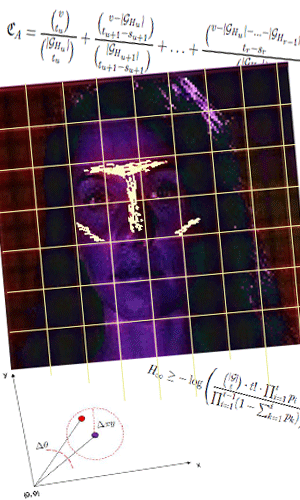
Biometric & Cryptography
The human corpora - A masterpiece of nature
A puzzle of individual modules - Causing every human to be unique.
Some might be very similar, even a spitting image.
But no one equals one another!
Yet what makes a human one of a kind
and thus so interesting for our application?
There are many possible ways to address this question!
The more one delves into the topic of biometrics and cryptography the more one becomes amazed by the decisive
power of a sensitivity towards the whole system success or failure.
Within the cryptographic domain a single bit altered may lead to either the loss of the secret or its total
concealment. Within the biometric realm, human details that are neglected unobserved in every-day life all of a
sudden become the crucial characteristics possessing the power to make every person a distinguishable unicum.
User authentication and access authorization are approached differently by biometrics and cryptography.
Their blend of concepts and techniques benefits from both strengths; complementing each other.
Given the increasing importance of reliably securing physical and digital assets, the
relevance of merging biometrics and cryptography is gaining higher priority.
Various governments, including the Australian government, have sought to establish
authentication frameworks for the purposes of encouraging opportunities to engage in
the secure delivery of e-government services. Central to the design of an authentication
framework is the identification of appropriate assurance levels and the corresponding authentication
mechanisms considered adequate for the perceived level of risk exposure.
Typically, traditional passwords and PINs are categorised as being suitable for minimal
to low risk transactions. For high risk transactions, recommended authentication
mechanisms may involve the combined use of cryptographic technologies along with
hardware tokens and biometrics. It is not surprising then to find that there is contemporary
research aiming for strongly combining cryptographic techniques with biometrics
to form so-called biometric cryptosystems.
Unlike a password or digital string, within those frameworks a biometric trait antidote
to identity theft requiring the eligible person to be present in order to submit
her/his biometric trait for being granted access or authentication. Consequently a biometric
cryptographic scheme can increase overall security and reduce identity fraud,
given liveness detection to counteract biometric fraud and forgery.
The biometric cryptosystem has two main aims:
- to eliminate the loss of privacy within common biometric systems by avoiding
data storage in the clear; and
- to enable biometric protected storage and retrieval of a committed cryptographic
key which can be used for further security applications or high risk transactions.
Before exploring the biometric cryptosystem further, we initially introduce the two major
areas involved,
Biometrics and
Cryptography.